
Imagine you’re holding a piece of metal — maybe part of a car, an airplane or even a medical device. To most of us, it looks solid and uniform. But if you could zoom in far enough, you’d see a complex inner world made up of tiny patterns, grains and structures. These small details — called the microstructure — help determine how strong, durable or safe that material really is.
I lead a Los Alamos National Laboratory team that focuses on understanding and predicting how those tiny internal features affect the performance of full-size parts.

Why does this matter? Because sometimes, those microscopic details make the difference between something working perfectly or failing catastrophically. In one tragic case in 1996, a failure in an airplane engine was traced to a small change in the material’s internal structure introduced during manufacturing. That flaw led to a crack — and ultimately a fatal accident. Situations like this show just how important it is to understand what’s happening inside materials, not just on the surface.
But we don’t just work to prevent failures. We also want to make things better.
By adjusting our manufacturing processes, we can create stronger, lighter and more reliable materials. Through careful control of material processing, we can reduce potential defects. With technologies like 3D printing, we can even design intricate lattice-like structures that are lightweight but incredibly sturdy. These kinds of improvements can lead to safer cars, more efficient airplanes and lower energy use.
The challenge is incredibly complex. A finished part’s behavior depends on many interacting factors, which fall into three broad categories: how it was made, what its internal structure looks like and how it will be used. Running physical experiments for every possible combination would be slow and expensive.
That’s where our work comes in.
Fierro is a virtual testing lab where engineers can explore what-if scenarios.
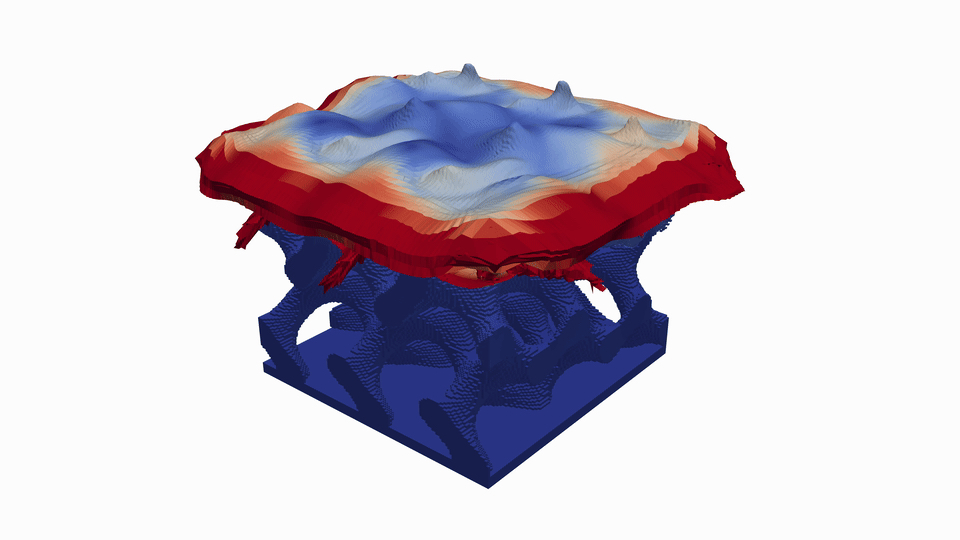
We develop advanced computer software, called Fierro, to simulate how materials behave, from microstructure scales all the way up to the full part. Fierro is a virtual testing lab where engineers can explore what-if scenarios without building and breaking real prototypes, modeling how materials deform, how cracks form and how different manufacturing processes affect the final product. It breaks a material down into small pieces and calculating how each component responds to forces and other conditions. Then it combines that information to predict how the entire part will behave.
For creating Fierro, our team won an R&D 100 Award — an honor often described as the Oscars of innovation. This recognition highlights both the technical advances behind the software and its potential impact in engineering and manufacturing.
Fierro connects the dots between different scales. It links microstructure to material properties and finally to how the part performs. This big-picture view is essential for designing better materials and products.
Another important aspect is speed. These simulations are very demanding, so we built Fierro to run on powerful computers, including systems that use both traditional processors (CPUs) and graphics processors (GPUs). This flexibility allows us to run detailed simulations much faster than would be possible otherwise, making it practical to use these tools in real engineering workflows.
We also made Fierro open source. As a result, researchers, engineers and organizations can collaborate more easily and avoid the high costs and limitations of some commercial software. By making these tools more accessible, we hope to accelerate innovation across many fields.
The impact of this work goes beyond individual parts or products. Manufacturing supports the U.S. economy, national security and global competitiveness. Better design and evaluation tools like Fierro can help companies respond more quickly to supply chain challenges, reduce costs and develop more sustainable technologies.
Our long-term goal is giving engineers the ability to design materials and parts with confidence, knowing exactly how they’ll perform before they’re built. That means safer products, more efficient manufacturing and new possibilities for innovation.