


Nothing is ever truly still. Every atom, everywhere in the universe, is constantly moving. We perceive this inherent buzz as temperature, and it marks the difference between a silent, dead universe and one full of life. Temperature drives change and bridges scales, from microscopic to galactic. It drives tiny motors in human cells that transport vital nutrients, spreads perfume through a department store and even prevents stars from collapsing under their own weight. To understand these vast effects, I study solids, where atomic motion is tightly confined. Atoms do not wander; instead, they expend their energy vibrating around a fixed position.
Even in a solid, such as a grain of sand, the atomic world is chaotic and complex. Each grain contains roughly as many atoms as there are grains of sand on Earth. Each atom interacts with dozens of others, creating a tumultuous landscape of particles moving in every possible direction. However, if any single atom goes too far in any direction, a neighboring atom pushes back. This confinement means that all atoms experience the same environment. Therefore, we can track the oscillations of a single atom to understand the whole system.
This single atom, like every other atom in the system, is surrounded by neighbors on all sides. This closeness turns the motion of just one atom into a coordinated ripple across the system. One atom nudges the next, and the energy flows like the wave in a crowded stadium until it reaches the other side. The messy cascade of energy spreads in all directions due to the constant jostling of atoms and is the process through which sound and heat are transmitted. We can understand this randomness by leveraging the wavelike propagation of heat and sound to further simplify the system.
Without asymmetry, solids would not melt, sounds would ring on forever…
An atom’s behavior can be viewed as a boulder rolling back-and-forth in a valley. This valley represents the atom’s potential energy. The same math used to describe the cyclic motion of a pendulum or a child’s swing also describes the boulder rolling in the valley. When that energy valley is symmetric, specifically a parabola, high school-level math can describe a material’s properties within 10% of their true values. Just by knowing how steep or shallow the valley is and how far apart neighboring atoms are, we can predict a material’s stability, strength, how much it will expand when heated and the amount of energy needed to change its temperature. Despite the awesome power of this simple approximation, real molecular systems need asymmetry. Without it, solids would not melt, sounds would ring on forever and heat would flow without resistance.
My research makes the symmetric model more accurate by accounting for the valley’s asymmetry. This imbalance mimics reality and is often very small. Despite the apparent insignificance of this extension, it expands equations that can be written in a few lines into an entire textbook, and computer programs that used to run in microseconds require hours on a supercomputer. All because of a tiny asymmetry.
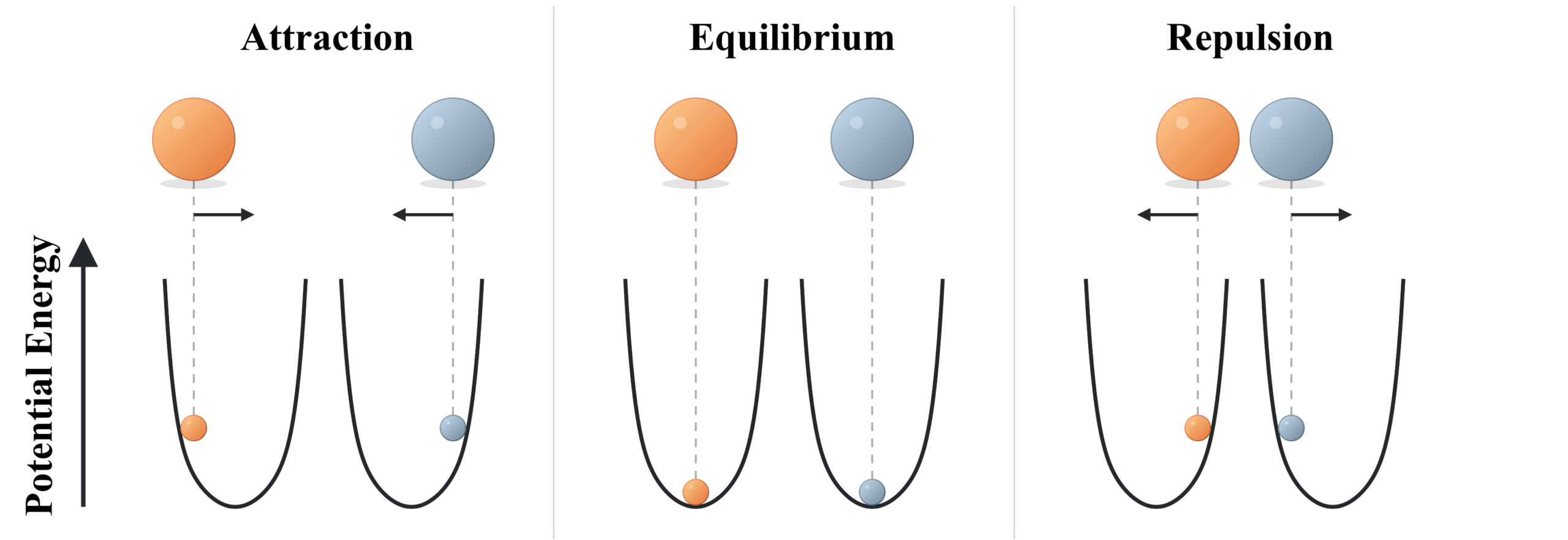
Since the 1960s researchers have understood the core ideas of this asymmetric theory, yet these concepts remained relegated for decades in hard-to-find textbooks. Although the original scientists considered their theory of solids complete, limited computing power prevented them from applying their equations. As a result, the expressions they derived often were oversimplified or unused. Only in the last two decades have researchers applied modern computing resources to these old equations. This combination can help researchers study important energy problems, such as using waste heat to generate electricity, designing thermal management systems to improve data centers’ efficiency and creating materials for extreme environments like hypersonic aircraft. Using these approaches, scientists have already discovered a material that conducts heat better than anything in nature and a cooling, super-white paint that reflects 98% of the sun’s energy.
To accelerate progress toward new and better materials, I operate as a computational physicist and science archaeologist. Tying together dusty, forgotten equations with a dash of new physics and the latest-and-greatest computational resources, I predict material properties with unprecedented speed and accuracy. I can study thousands of materials simultaneously, even materials never seen or synthesized before. Rapidly screening thousands of candidate materials makes finding the diamond in the rough not just possible, but likely. This computational filtering saves time and money by guiding real-world experiments toward worthwhile targets. The challenge is not to eliminate complexity when searching for new materials, but to embrace it and discover what gives a material its exceptional properties.
Materials with atoms vibrating in symmetric valleys do not exist. The asymmetries that turn succinct equations into hundreds of pages and make computer programs sluggish allow engineers to create incredible materials. By embracing these intricacies, my work turns previously impossible calculations into a practical method for identifying superior materials at scale. Even though simple and clean models are a starting point for understanding the enormous complexity of the universe, imperfections are the reality. They make the world unique, interesting and worth understanding.