
Deep in the Atlantic, an attack submarine’s silence is absolute, broken only by the quiet hum of the circulation pumps. For many months, I lived inside this steel tube with a crew of 120. We harnessed one of the universe’s most primal forces, the energy of splitting atoms, to keep the lights on and the propeller turning. It was a mastery of engineering that felt almost routine. As a submarine officer in the U.S. Navy, I understood that our lives depended on this controlled reaction. It was our heartbeat: steady, reliable, and engineered to perfection.

Yet as I stood watch in the glow of the instrument panels, I often thought about the other side of the nuclear coin. While we split atoms to stay hidden in the deep, physicists elsewhere smashed them together, mimicking the sun. Nuclear fusion, the process of combining light isotopes like hydrogen to release vast energy, promises a future of clean, inexhaustible power. But unlike the steady hum of a submarine reactor, fusion is violent and fleeting. It is less like a battery and more like a contained explosion. Now, as a computational scientist, I have traded the periscope for high-performance computing clusters, working to solve the hydrodynamic riddles that prevent us from stabilizing and shaping fusion burn.
My research inhabits the intersection of two disciplines: turbulent combustion and hydrodynamic instabilities, which occur as fluids mix. The connection lies in the physics of the ablation front, the boundary where solid fuel materials turn into hot plasma to trigger fusion reactions.
In inertial confinement fusion, powerful lasers blast a tiny fuel pellet, causing its outer shell to explode outward. This explosion drives a shockwave inward, compressing the fuel. This ablation front behaves mathematically like a premixed flame.
A premixed flame, like a gas stove’s blue ring, has its fuel and oxygen thoroughly mixed before it catches fire, in contrast to a candle that slowly draws oxygen from the air. Premixing allows it to burn intensely and rapidly. The ablation front of a fusion pellet acts like this high-energy, fast-moving flame. Just as a burner’s flame consumes fuel, transforming reactants into products, the ablation front consumes the shell, driving the compression necessary for fusion.
My transition from a submarine officer to a researcher has been a shift from operation to innovation.
Next consider turbulence, the disordered, swirling motion of a fluid, much like stirring milk into your morning coffee. In a car engine or a gas turbine, this vigorous mixing wrinkles the flame sheet, creating complex folds and pockets — a geometric surface. When these flame surfaces collide, they can extinguish each other or merge, significantly altering how the fuel burns. By studying the flames’ geometry, we can better understand the hydrodynamics of inertial fusion. I focus on these flame-flame interactions.
Using high-performance computing, I modeled premixed flames as they collided to understand the dynamics at the corners formed where flame fronts meet. Imagine two lines of fire merging at an angle: the point where they meet travels faster than the flame itself. I discovered that this corner speed follows a precise relationship with the collision angle. Surprisingly, this same physics also governs the stable tip of a Bunsen burner’s flame. By treating these complex chemical interactions as simple geometric shapes, we can predict how a flame will evolve and survive.
Turbulence is seemingly random, but this finding suggested that simple geometry could provide a predictable framework. Tracking every chemical reaction is prohibitively expensive in computational physics, so researchers look for ways to accurately simplify complex chemistry into fewer variables. To make these findings useful for larger physical simulations, I help develop models that act as mathematical compressors, simplifying complex chemistry into fewer variables. By tracking flame curvature and its dissipation rate, we can predict whether colliding flames survive without solving for every chemical species. It provides a low-cost way to simulate the shape of the flame.
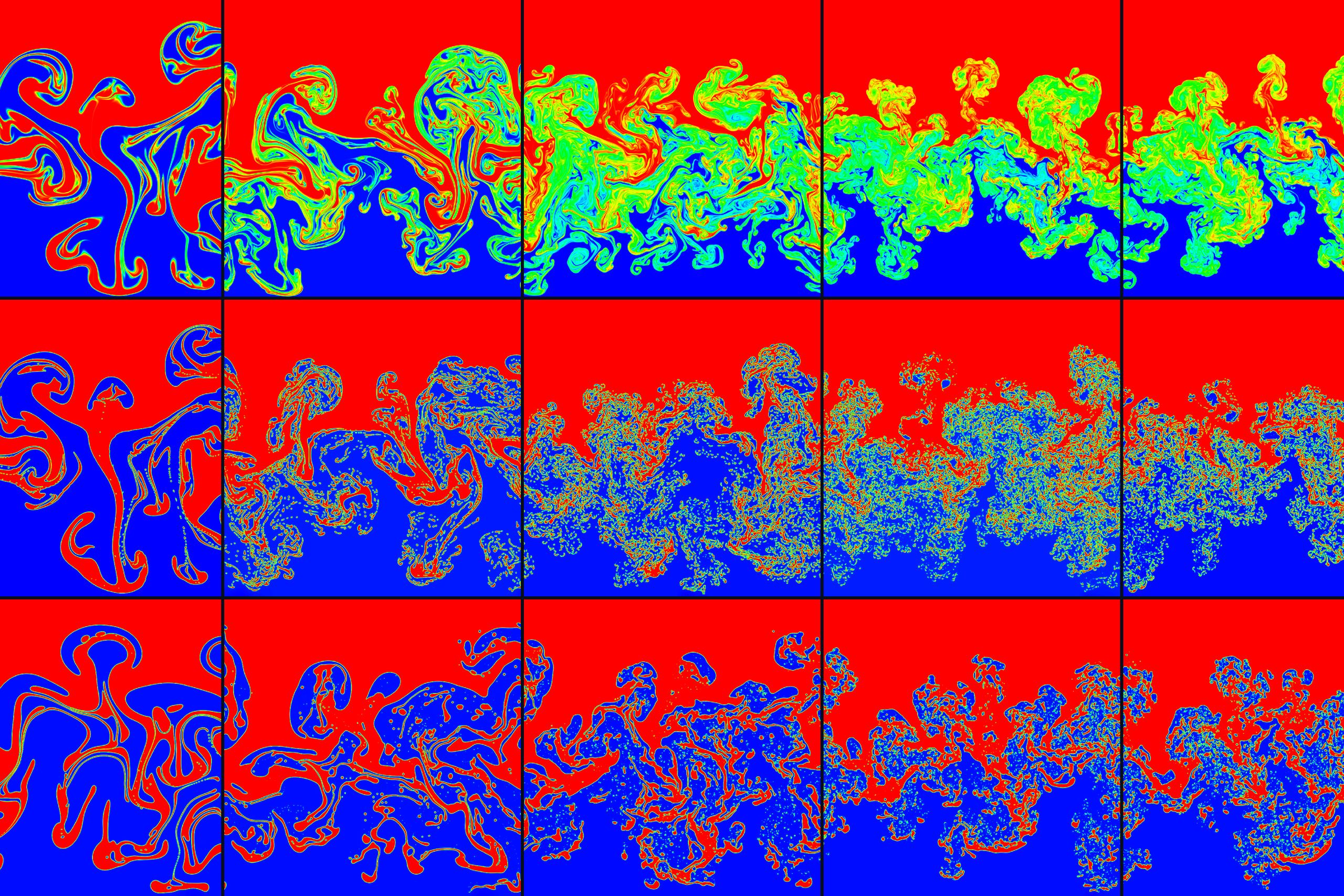
Whereas the ablation front behaves like a flame, the fuel inside the fusion capsule faces a different force: the Rayleigh-Taylor instability. As a light fluid pushes against a heavy one, the low-density fusion plasma slows the high-density fuel shell. This same phenomenon causes complex spikes and bubbles to form as oil rises in water or as wax rises and falls in a lava lamp. In a fusion target, these spikes inject cold shell contaminants into the hot fuel, quenching the reaction before it can ignite.
Running simulations on Department of Energy supercomputers, I focused on portions of the implosion where surface tension fights against the mixing, known as the immiscible regime. I tested many combinations of fluid properties, like viscosity and surface tension. Surface tension acts as a gatekeeper, like a skin between the fluids, suppressing the small-scale turbulence and preventing the fuel and shell from mixing too early. However, once the instability grows large enough to overcome this tension, the mixing layer grows rapidly.
My transition from a submarine officer to a researcher has been a shift from operation to innovation. On the boat, we worked as a team to maintain a steady state, to keep the reactor critical and the ship quiet. In research, the goal is to disrupt, to find the instabilities and understand them.
The ultimate objective, however, remains aligned. By viewing a fusion pellet through the lens of combustion theory, we gain a new set of mathematical tools to analyze its failure modes, building on centuries of combustion science to predict its behavior. The path to fusion energy and a long, submerged transit both require navigating through the unknown, relying on precise calculations, and trusting that the physics will hold. We mastered the energy of the atom to sail the oceans; with continued cross-disciplinary inquiry, we will master the physics of fusion to power our world.