
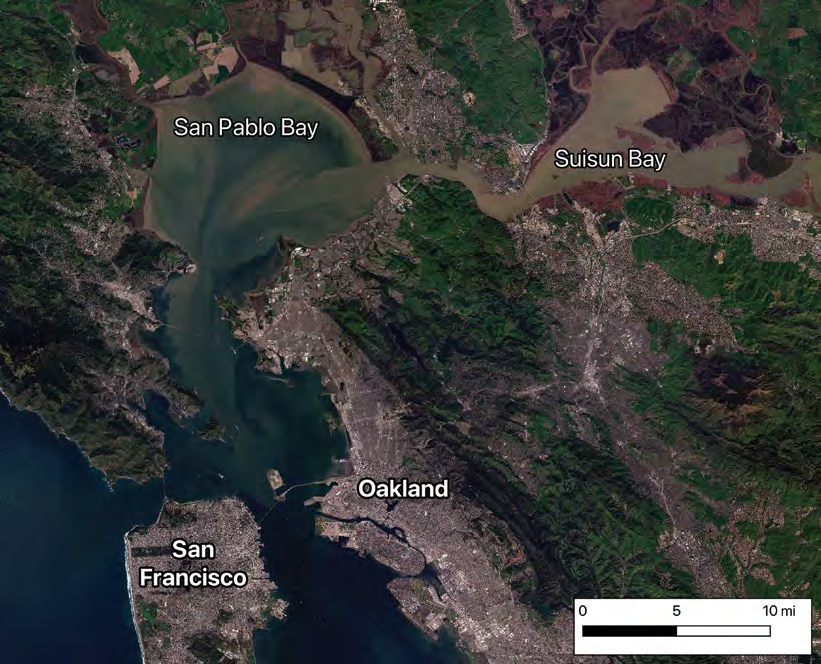
In February 2018, I was aboard a small research vessel named the Questuary in Suisun Bay, at the edge of the Sacramento-San Joaquin Delta. Around midnight, a winter storm moved in. Waves kicked up thick clods of detritus onto the windshield, and nearly everyone was seasick. The bathroom was fully out of commission.
But there was no time to bemoan our dire circumstances: We had measurements to take. Every 15 minutes, a crew of Ph.D. students collected water samples on deck as waves rocked the boat side-to-side. Below, I was busy fighting battles of my own. My duty was to hold a pipette over an aquarium tank and use a camera to film sinking particles of sediment.
Every now and then, one would float upward, indicating the boat’s motion had jostled the tank too much and the measurements were useless, forcing me to start the whole process over again.
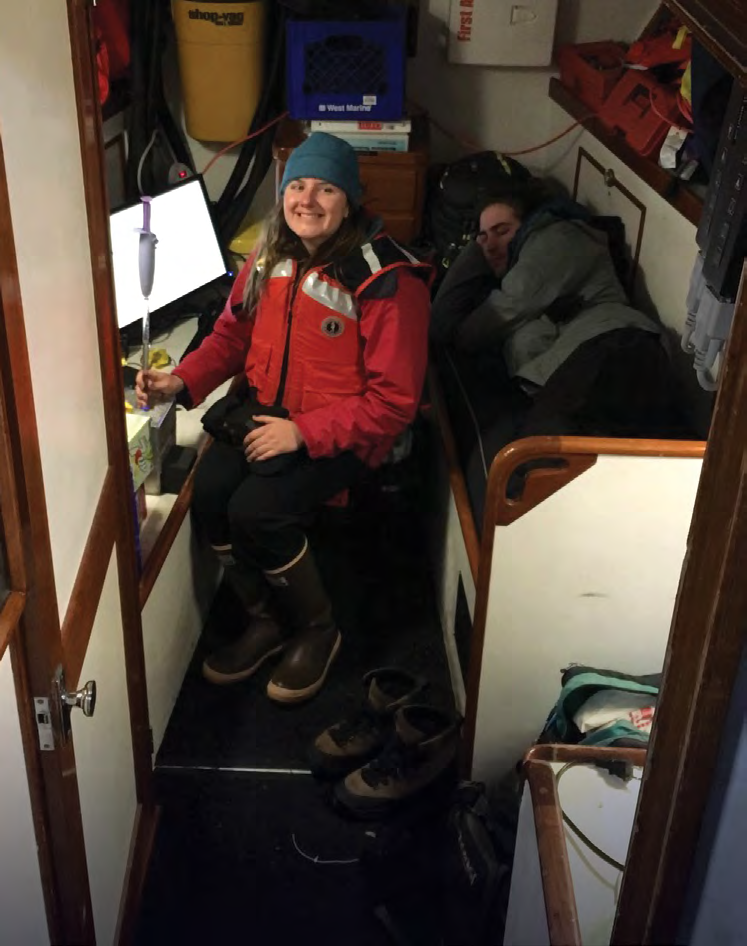
the Questuary as a weary graduate student attempts to rest. Photo: Sienna White.
Measuring how quickly a particle of sediment falls through the water is difficult, even under ideal conditions. This speed, often referred to as a settling velocity, might seem unimportant to the untrained eye. At 3 a.m., it certainly felt marginal to me. But if you are studying whether a marsh will erode, or how the baylands of south San Francisco Bay might look in 50 years, you need to know how much sediment will travel from point A to point B. And then, suddenly, it’s useful to know how long a particle will float in the water before it sinks to the bed.
Complicating the matter is a process known as flocculation. Sediment in estuaries has a curious ability to clump together like ice crystals in a snowflake, forming tiny, fractal amalgamations known colloquially as “flocs.” Depending on how tightly the particles adhere, the floc might be large and fluffy or small and dense. This all affects how quickly the floc sinks.
Now you have sediment that can be one settling speed, before it sticks to another piece of sediment and starts to sink at a different rate. If you don’t know when or where these interactions will happen, you can’t confidently predict when and where that sediment might settle. In fact, flocculation is widely considered the largest contributor of uncertainty in estuarine sediment transport models.
‘For a long time, I thought I had escaped the siren song of sediment dynamics.’
After my night in Suisun Bay, I attempted to transition into more glamorous subfields of coastal oceanography. I worked on biogeochemical models, studied things like phytoplankton dynamics and stratified turbulence. For a long time, I thought I had escaped the siren song of sediment dynamics.
However, six years later, during my Ph.D., I learned about inverse methods designed to constrain and ultimately improve our understanding of complicated processes. I began to wonder if some of the methods successfully applied in weather forecasting and signal processing might also work for sediment transport modeling.
Now, I aim to quantify how flocculation impacts sediment transport models using a method called an ensemble Kalman filter.
You interact with the output of an ensemble Kalman filter whenever you check a weather forecast. Have you ever stopped to wonder why one area might have a 40% chance of rain, but another area nearby has a 90% chance? Ensemble Kalman filters allow us to explore how uncertainties in a modeled prediction change not only as a function of time but also as a function of space.
The filter works like this: Instead of running one model and trusting the output as a guaranteed outcome, we run a set of models (the ensemble) in parallel, with the starting point for each model perturbed just a tiny bit. As they run, we adjust each simulation using real-world data, to make each result as accurate as possible. Then we compare the simulations’ results.
When a system is particularly chaotic, tiny variations in the initial conditions or modeled processes result in dramatically different outcomes. Using an ensemble Kalman filter, I now explore how sensitive our models of suspended sediment transport are to slight changes in the flocculation process.
This work has two outcomes. First, we can better estimate the average size of sediment particles in San Francisco Bay over a given day, which allows us to apply an appropriate settling velocity within a large-scale sediment transport model.
The second, and perhaps more interesting, opportunity: We can explore when and where flocculation produces large uncertainties in sediment transport model results. For example, when the tide is coming in and currents are strong, producing turbulence near the bed, will our sediment transport model be more or less accurate? And how does that uncertainty change as you move up or down in the water?
I used to think of sediment transport as a zero-sum game. As a numerical modeler, I wanted to work with exact equations that would consistently produce the right answer. I didn’t want to deal with complex biogeochemical processes. What was the point of studying something so complicated, so stochastic, with sky-high error bars?
Now, however, I see it as an exciting challenge. With the right data and methods, we can improve our understanding of many important aquatic processes by exploring and characterizing the uncertainties they produce.
No more late-night boat rides or seasickness for me. Just a thousand different models of sediment floating through the waters of San Francisco Bay.
This is the winning essay, reprinted from the DEIXIS research annual, of the 2026 DOE CSGF Communicate Your Science & Engineering Contest, which invites fellows and alumni to write about computational science for a broad, nontechnical audience.