
Ever since Einstein wrote E=mc2, scientists have dreamed of harnessing the power of atoms. Nuclear fusion can provide vast amounts of energy from a small amount of fuel. Understanding how fusion works is one thing. Making it work is quite another. Creating a sustained fusion reaction so that it produces net energy is a goal that seems perpetually beyond reach.
In other words, it’s the perfect problem for Tom Gade.
“I like hard things,” says Gade, a Department of Energy Computational Science Graduate Fellow (DOE CSGF) working toward his Ph.D. in plasma physics at the University of Minnesota. He studies how superheated plasma in a fusion reactor moves and evolves over time — a crucial piece of the fusion-power puzzle. Gade is especially interested in so-called magnetic islands, or structures formed when magnetic lines reconfigure and reconnect to form loops within the plasma that alter its behavior.

“Plasma physics is this unique thing,” Gade says, “requiring multiple skills to do much of anything.” To understand reactor plasma’s evolution, he enjoys combining expertise in numerical methods, applied mathematics, high-performance computing, thermodynamics, electricity and magnetism, and classical mechanics.
Gade knew he wanted to be a scientist at age 5 but also pursued other passions. After high school, he enlisted in the Army National Guard and completed an undergraduate physics degree at The Citadel in South Carolina. After college, he chose to attend seminary, interrupted by an 18-month deployment in Afghanistan. In 2014, he started a job at 3M working on thin-film optics and assumed a command position of an armored tank company in the National Guard.
After two years, the lure of physics called him back. He worked as a research assistant at the University of Minnesota and completed a master’s degree in computer science. He applied to graduate schools and established a relationship with the Princeton Plasma Physics Laboratory (PPPL). Eventually, he was awarded the DOE CSGF.
Experiencing life beyond academics “before coming back to grad school has given me a bit of maturity,” Gade says. “Everybody’s got insecurity and impostor syndrome. I think the fact that I’ve seen so much in life helps me mitigate some of that.”
Gade works on modeling the plasma within tokamaks — giant donut-shaped fusion reactors that hold plasma in place with the help of magnetic fields. These fields confine the plasma to keep it from the metal reactor wall. Contact with the wall would cause metal to sputter into the plasma, cooling it and quenching the reaction while creating a host of other negative effects.
‘Plasma physics is extraordinarily challenging because of the wide range of scales.’
Charged particles in the plasma typically follow the surfaces created by the magnetic field lines, tracing out helical paths as they move around the tokamak. But in practice, magnetic field lines don’t always play nice.
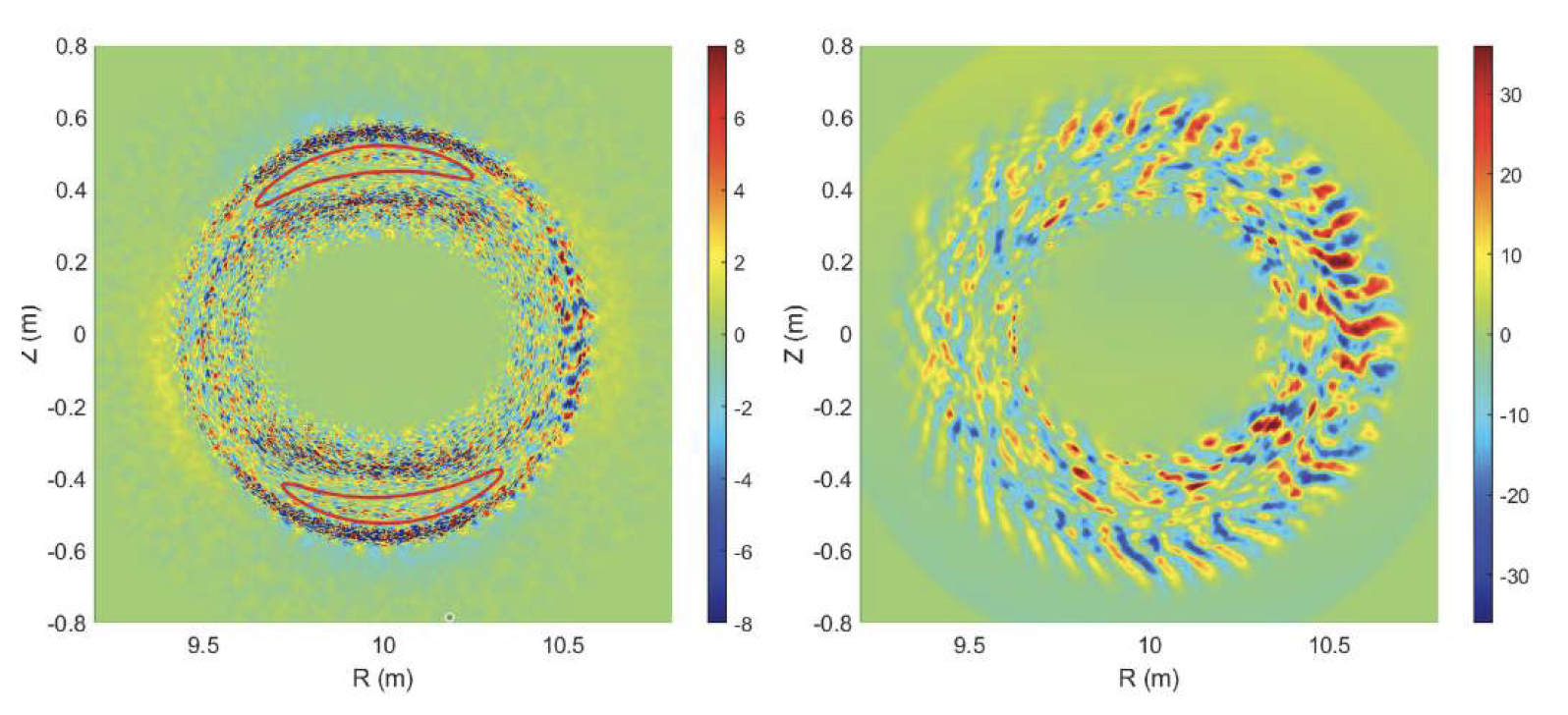
Gade compares the flow to a river streaming rapidly between two banks. “But as you approach either shore from the middle, the speed of the river’s flow drops off or slows down,” he says. “Neighboring regions move at different speeds and rub against each other.” This creates a shear that can tear magnetic field lines, causing them to reconnect and form magnetic islands. The cross-section of a magnetic island is banana-shaped and at a lower energy state than the river of plasma flowing around it, complicating the plasma particles’ movement.
Though magnetic islands create disorder inside the tokamak, their presence isn’t all bad. “They’re a double-edged sword,” Gade explains. On one hand, they minimize the outward trajectory of particles in the plasma, aiding in confinement. Then again, they sometimes cause particles to be transferred outward to other parts of the plasma in unexpected ways, a phenomenon called density pump out.
“Our goal is to understand whether these islands are more helpful than harmful, and if they’re helpful, then to work with them,” Gade says. “Plasma physics is extraordinarily challenging because of the wide range of scales, both space scales and timescales that have various physical processes happening within the plasma. You’re almost always making some manner of simplifying approximation. You’re cutting out some of that physics to make the simulation tractable.”
This complex problem needs an immense amount of computing power. Gade uses a code called XGC designed to model a magnetically confined fusing plasma’s edge, “physics that we just haven’t understood before,” he says.
This code encapsulates different physical properties across significant ranges of space and time. It can model effects among clumps of ions, a few tens of micrometers, up to the entire tokamak, a couple tens of meters, and from 60 microseconds to several milliseconds. Features just a hundredth of the plasma’s radius can have a global impact on the system, Gade says.
“Understanding this interaction between these modes is crucial because small fluctuations can influence the growth of large tearing modes,” says Robert Hager, Gade’s DOE CSGF practicum supervisor at PPPL, where the code was created.
The XGC code allows most of the important physics to be included while simplifying other effects to speed up the simulation. For instance, XGC averages the trajectory that charged particles in the magnetic field will follow, enabling users to model more of the process than previously possible. Gade also includes nonlinear effects, which may be significant in the long-term system’s evolution.
Gade first worked at PPPL in 2023 and planned to return to simulate plasma conditions that form magnetic islands.
This article was adapted from the 2026 print edition of DEIXIS: The DOE CSGF Annual.