
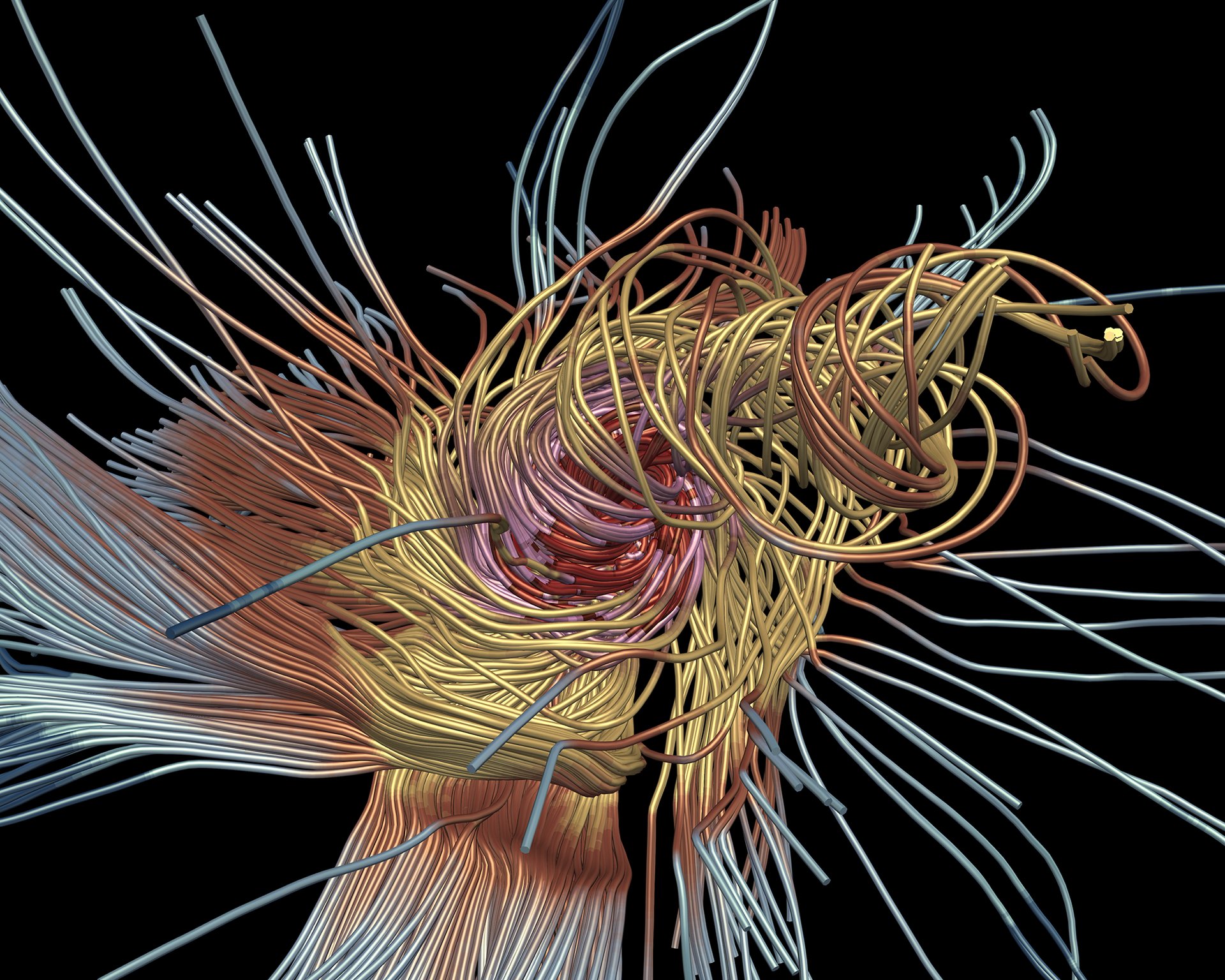
Earthlings see one star, the sun, when they look into a clear sky during the daytime. The fictional denizens of the bleak Star Wars planet Tatooine, however, see two suns.
Nearly half, and perhaps many more, of stellar systems in the Milky Way galaxy consist of two or more stars. Some evidence suggests our sun formed with a companion star that was stripped away. How systems form with multiple, gravitationally bound stars remains an open question, says Nina Filippova, a fourth-year Department of Energy Computational Science Graduate Fellow (DOE CSGF). A Ph.D. student in astrophysics at the University of Texas at Austin, Filippova performs supercomputer simulations to understand how protostellar disks of gas and dust form around young stars.

“If you think about our solar system, for example, we have planets orbiting in a singular plane,” she says. “That’s good evidence that our star at one point had a disk of material around it, kind of like Saturn’s rings.”
Protostellar disks in nearby star-forming regions can be seen through telescopes encircling young stars. Conservation of angular momentum, the same phenomenon behind spinning figure skaters, plays a key role in their formation. When skaters go into a spin, “they have their arms stretched out wide. Then they pull them in tightly and they start spinning faster,” explains Filippova, a former figure skater. “That’s angular momentum conservation in action.”
As protostellar disks form, a massive ball of gas and dust collapses via gravity to form a star. If the cloud is rotating around a young star, angular momentum sustains a disk. “This is a general phenomenon,” Filippova notes. “Spiral galaxies also rotate because of conservation of angular momentum. Black hole accretion disks form because of conservation of angular momentum.”
Magnetic fields also contribute significantly to star-formation dynamics. The magnetic fields become coupled to charged ions, atoms and molecules in gas clouds. Various theories of star formation suggest that with firm coupling between the magnetic field and the gas, the magnetic field acts as a brake on rotation, preventing a disk from forming.
She realized that she would need to become computer-savvy if she wanted to do physics research.
Filippova’s work springs from what astrophysicists call “the magnetic braking catastrophe,” a tension between these theories that magnetic fields curb rotation and observations linking such disks in gas clouds with strong magnetic fields. She depends on three numerical methods — “the ingredients that I use to run my simulations,” called Gizmo, Turbsphere and Starforge — to perform her simulations. Gizmo solves the equations. Turbsphere provides realistic conditions for the star-forming process. Then Starforge describes the behavior of the newly forming stars. “Gizmo plus Turbsphere plus Starforge equals realistic star formations,” she says.
Filippova’s father, Andrey Filippov, a physicist, was the first to inspire her love of science. A high school chemistry teacher further sparked her scientific interests. She fell in love with physics, which became her major at Princeton University. At first, she confesses, computer science and computer programming made her nervous. So, at Princeton, Filippova assumed she would solve equations with pen and paper.
Then came a summer program in biophysics at the University of Utah. “I had to write some code to simulate a laser beam,” she says. “The code that I wrote was very ugly, very clunky. I’m sure it took 10 times longer to run than it should have, but it worked.”
She took part in a summer 2018 workshop on mapping distant galaxies’ emission lines — a colored barcode generated by the elements in hot gases — at the National Observatory of Japan. There, she worked with numerically simulated data to prepare for the analysis of actual data generated by NASA’s SPHEREx satellite mission, which launched in March 2025, and decided “that seems like a field I want to specialize in.”
Back at Princeton, she used Python and realized that she would need to become computer-savvy if she wanted to do physics research. She took courses in computer science, algorithms and machine learning. After enlisting Eve Ostriker as her undergraduate thesis adviser at Princeton, she ran her first star-formation simulations.
That interest led her to UT and Ph.D. adviser Stella Offner. Since then, Filippova has performed simulations on the Frontera supercomputer that incorporate the physics behind star formation. Frontera solves equations millions of times faster than she could by hand.
Filippova’s undergraduate training — in quantum mechanics, thermodynamics, and electricity and magnetism — has come together in her astrophysical simulations, which must consider the interplay of gravity in gas-cloud collapse and the thermal pressure that supports the gas against gravity.
Filippova’s DOE CSGF acceptance came with a program of study in theoretical computer science. The fellowship also included a summer practicum in 2023 at Los Alamos National Laboratory. There, she focused on using machine learning to map magnetic fields in star-forming regions. “There’s hope in astronomy that we can use machine learning to speed up the simulations,” she says. “If I had stayed scared of programming and using computers, I wouldn’t have access to any of this research now.”
After completing her Ph.D., Filippova plans a career in academia, starting with a postdoctoral position. “I hope to continue using numerical simulations to study star formation, perhaps with a broader scope than just disk formation.”